The best motorbike helmet is a new, genuine, certified full-face helmet that matches your head shape, stays securely in place, and remains comfortable throughout a normal ride. For most road riders, full-face construction offers the strongest balance of head coverage, facial protection, weather shielding, and everyday usability.
Certification alone does not make a helmet suitable. A highly rated helmet that moves around, creates severe pressure points, obstructs vision, or does not suit the rider’s environment is the wrong choice. The final decision should be based on five essentials: legal approval, correct fit, appropriate helmet type, practical comfort, and trustworthy condition.
This Which Motorbike Helmet Should I Buy FMBMotoGear guide explains how to evaluate those factors without relying on price, appearance, or marketing claims.
The Short Answer for Most Riders
A road rider should begin with a full-face helmet carrying the current approval required in the country where it will be used. ECE 22.06 is a strong modern benchmark in markets that recognize UN Regulation No. 22. Riders in the United States should verify compliance with DOT FMVSS No. 218, while those buying for track use must also check the organizer’s specific helmet rules.
The helmet should:
- Fit firmly around the entire head without painful pressure points
- Grip the cheeks securely
- Resist movement when rotated with the chin strap fastened
- Provide a clear field of vision
- Remain stable at normal riding speeds
- Include effective ventilation and visor demisting
- Be new, undamaged, and obtained from a reliable seller
- Carry genuine approval labels rather than decorative stickers
Brand reputation and shell material can help narrow the options, but neither compensates for poor fit. The safest purchase is not automatically the most expensive helmet; it is the properly approved model that fits the individual rider correctly.
Start With the Safety Standard
Safety approval should be checked before graphics, Bluetooth compatibility, visor tint, or shell finish. A legitimate label shows that the model was designed to meet a defined set of impact, retention, field-of-vision, and structural requirements.
ECE 22.06
ECE 22.06 is the current version of the widely recognized UN motorcycle helmet regulation. Compared with its predecessor, the standard evaluates helmets through a broader range of impact conditions and includes testing related to oblique impacts. Approved helmets can be identified through their regulation label and approval markings.
A buyer should inspect the actual label rather than accepting a product-page claim. The approval must cover the helmet configuration being purchased, particularly when selecting a modular model.
DOT FMVSS No. 218
In the United States, road helmets should meet Federal Motor Vehicle Safety Standard No. 218 and display the required DOT marking. The NHTSA helmet guide explains how riders can identify compliant helmets and recognize warning signs associated with novelty headwear.
A DOT sticker by itself is not proof that an unknown helmet is genuine. Proper manufacturer information, permanent interior labeling, a substantial energy-absorbing liner, a secure retention system, and reputable distribution all matter.
Snell Certification
Snell certification is voluntary and is commonly considered by performance and competition riders. It can provide an additional reference point, but riders should check the exact standard and the rules of their track or racing organization. Not every competition accepts every certification.
SHARP Ratings
A legal approval is a pass requirement; an independent rating can offer additional comparative information. The UK government’s SHARP scheme publishes test results for specific helmet models. A SHARP rating is useful only after the rider has found a helmet that fits correctly. A higher-rated but poorly fitting model is not a sensible substitute for a secure, comfortable one.
Choose the Helmet Type Around Real Riding
Different helmet designs solve different problems. The best choice is the one suited to the routes and conditions the rider encounters regularly.
|
Helmet type |
Best suited to |
Main advantage |
Important limitation |
|
Full-face |
Commuting, road riding, sport riding and touring |
Extensive head and facial coverage |
Can feel warmer or less convenient at stops |
|
Modular |
Touring and frequent urban stops |
Hinged chin section improves convenience |
Heavier and mechanically more complex |
|
Adventure |
Mixed road and light off-road riding |
Peak, broad view and strong ventilation |
Peak may create wind resistance at speed |
|
Off-road |
Trail, motocross and dirt riding |
Airflow, goggle space and low-speed usability |
Usually unsuitable for sustained road use without the correct road approval |
|
Open-face |
Low-speed urban or scooter use |
Wide visibility and an open feel |
No fixed chin and facial coverage |
|
Half helmet |
Minimal-coverage riding where lawful |
Light and compact |
Considerably less coverage than full-face designs |
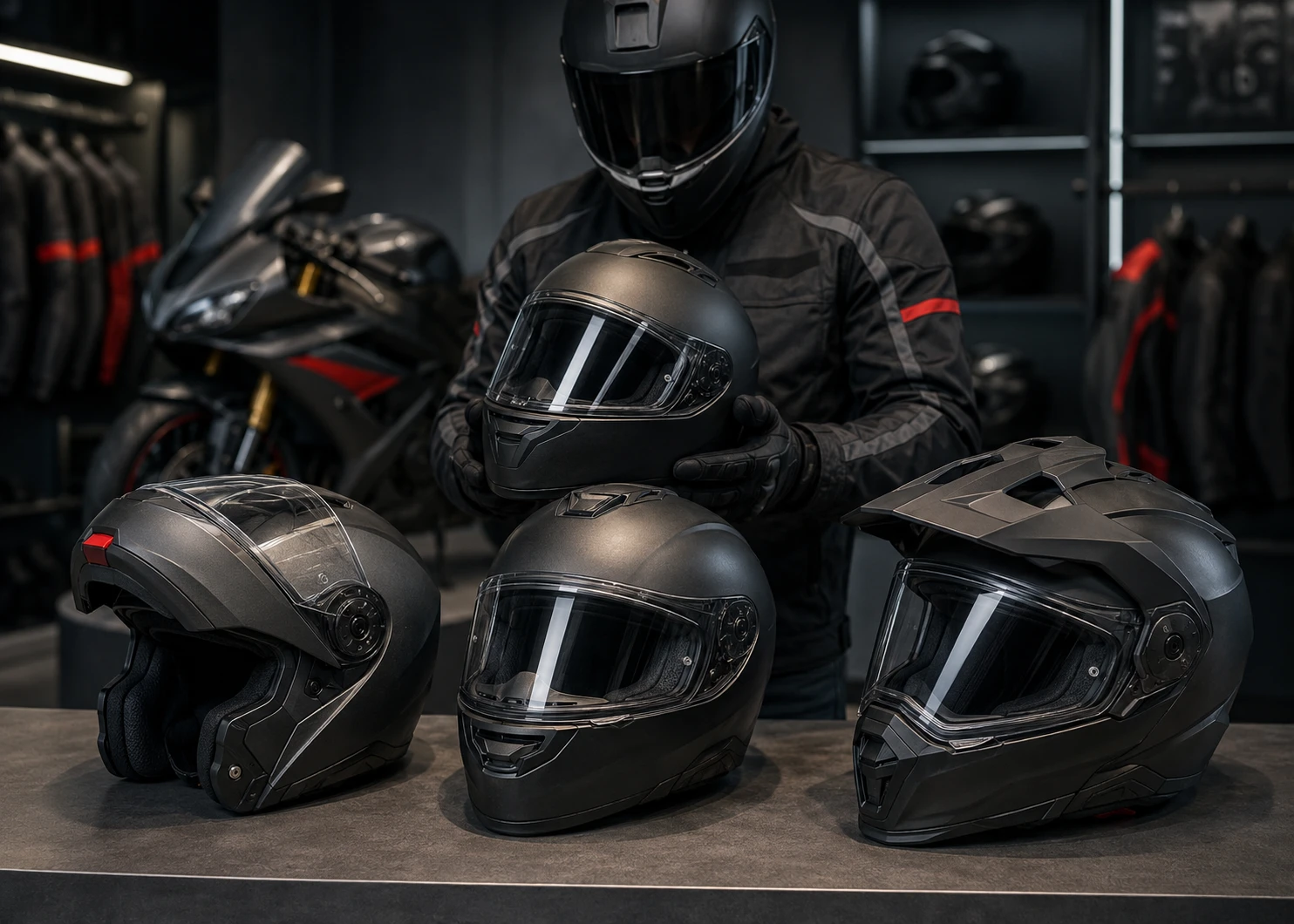
Full-Face Helmets
A full-face helmet is the most straightforward recommendation for a typical road rider. Its fixed chin bar covers an area left exposed by open-face and half helmets. It also protects the eyes and face from insects, grit, rain, wind, and cold air.
Commuters should prioritize a broad visor opening, effective vents, a washable liner, and an anti-fog-ready visor. Sport riders may value aerodynamic stability and secure visor locking, while tourers should also consider noise control and communication-system compatibility.
Modular Helmets
A modular helmet has a chin bar that lifts for convenience. It can work well for touring, refuelling stops, and riders who need easier face access. The additional hinge and latch mechanism normally make this design heavier than a comparable full-face helmet.
Buyers should confirm how the helmet is approved. Under ECE marking conventions, “P” relates to protective chin-bar use, while a properly approved dual-homologated modular model may carry “P/J” marking for use in both closed and open configurations. A raised chin bar can affect balance and aerodynamics, so it should only be used while riding if the helmet is approved for that configuration and local law permits it.
Adventure and Off-Road Helmets
Adventure helmets combine elements of road and off-road designs. They typically have a peak, generous ventilation, and space around the eye port. They suit riders who genuinely divide their time between pavement and trails.
A large peak can catch air at motorway speeds. Riders who spend nearly all their time on paved roads may be better served by a quieter, more aerodynamic full-face touring helmet.
Dedicated off-road helmets are designed around physical effort, dust, goggles, and lower average speeds. Road legality must be verified separately rather than assumed from their appearance.
Open-Face and Half Helmets
Open-face helmets leave the chin and lower face exposed, while half helmets provide even less coverage. They may be legal in some regions, but legality and coverage are different questions.
For riders deciding purely on protection and everyday versatility, a certified full-face helmet is generally the more complete choice.
Correct Fit Matters More Than the Size Printed on the Box
Helmet sizes are not standardized across manufacturers. A medium from one brand can feel entirely different from a medium made by another. Internal shape also varies between models.
Heads are often described as:
- Round oval
- Intermediate oval
- Long oval
These descriptions refer to the outline viewed from above, not simply head circumference. A size chart provides a starting point; an actual fitting determines whether the helmet is suitable.
Measure the Head Properly
Use a soft measuring tape around the widest part of the head, normally just above the eyebrows and ears and around the fullest point at the back. Keep the tape level and record the measurement in centimetres. Compare it with the chart for the exact manufacturer and model.
If the measurement falls between two sizes, try both. Do not automatically choose the larger one.
Perform a Secure-Fit Test
Put the helmet on, fasten the strap, and check the following:
- The lining should maintain even contact around the head.
- The cheek pads should hold the cheeks firmly without causing pain.
- Turning the helmet should pull the skin rather than allow the shell to slide independently.
- The helmet should not roll forward over the eyes or lift easily from the rear.
- The strap should remain snug beneath the chin.
- Vision should stay clear in the normal riding position.
New cheek pads can feel firm and may settle slightly with use. The helmet should not, however, cause sharp pain, numbness, a concentrated forehead mark, or intense pressure at the temples.
The government-backed SHARP fitting guidance recommends measuring first, securing the strap, checking rotational movement, and keeping the helmet on long enough to identify discomfort.
Wear It Before Making the Decision
Keep the helmet on for approximately 15 to 30 minutes in the shop when possible. Slow pressure points often appear only after several minutes. Check the fit while wearing any glasses, earplugs, or thin head covering normally used during a ride.
Never place thick clothing under a helmet. It can alter the fit and reduce stability.
Features That Produce Real Everyday Value
Once certification and fit have been resolved, practical features can separate two otherwise suitable helmets.
Visor Clarity and Fog Control
The visor should provide a clear, distortion-free view across the usable field of vision. Confirm that it closes securely and can be operated while wearing gloves. A Pinlock-ready or comparable anti-fog system is valuable in rain, cold weather, and humid conditions.
A dark visor can improve daytime comfort but may be unsafe or unlawful at night. Carry a clear visor when riding conditions could change.
Ventilation
Effective ventilation helps manage heat, humidity, and visor fogging. The vents should be easy to operate with gloves. More vent openings do not automatically mean better airflow; internal channel design and the rider’s position also affect performance.
Noise and Aerodynamic Stability
No motorcycle helmet makes high-speed wind exposure harmless. Helmet shape, motorcycle windscreen height, mirrors, riding position, and surrounding airflow all influence noise. Proper motorcycle earplugs remain advisable on longer or faster rides.
A stable helmet should not lift, shake, or pull the rider’s head excessively during normal use.
Retention System
Both double-D and micrometric buckles can be effective when properly designed, adjusted, and secured. Double-D rings are common in racing because they are simple and widely accepted by track organizations. Micrometric systems provide convenient fastening for everyday riding.
The strap must sit securely beneath the chin. A premium shell cannot protect properly if the retention system is left loose.
Removable Interior
A removable, washable liner improves hygiene and makes long-term maintenance easier. Replacement cheek pads can also help restore fit as the lining wears, provided the parts are designed for that exact model.
Communication Compatibility
Speaker recesses and manufacturer-approved mounting positions are useful for navigation or rider communication. Do not cut the energy-absorbing liner to install speakers, wiring, or brackets. Any accessory must avoid interfering with the visor, strap, shell, or helmet structure.
For a wider look at coordinated protection beyond the helmet, the FMBMotoGear guide covers jackets, gloves, boots, and other essential equipment.
Do Shell Materials Decide Which Helmet Is Best?
Common shell constructions include thermoplastic, fiberglass composite, aramid blends, and carbon-fiber composites. These materials can influence weight, shell thickness, manufacturing cost, and impact-management strategy.
Carbon fiber is not automatically safer simply because it is lighter or more expensive. Helmet performance depends on the complete structure: shell, energy-absorbing liner, comfort padding, retention system, visor mechanism, and overall design. Certification and model-specific test results provide more useful evidence than material names alone.
When two approved helmets fit equally well, lower weight may improve comfort on long rides. Balance is just as important as the number printed on a scale; a slightly heavier but well-balanced helmet can feel better than a lighter model with poor weight distribution.
Set the Budget in the Right Order
A higher price may pay for lower weight, a quieter interior, better ventilation controls, premium finishes, replaceable components, or improved visor mechanisms. It does not justify sacrificing fit.
Prioritize spending in this order:
- Genuine legal certification
- Secure fit and appropriate internal shape
- Coverage suitable for the riding environment
- Optical quality, ventilation, and fog management
- Comfort and replaceable interior parts
- Convenience features and appearance
A plain certified helmet that fits correctly is a better purchase than an expensive graphic model that shifts on the head. Riders assembling a full protective kit can use the broader gear buyer’s guide to allocate their budget across the remaining equipment.
Why a Used Helmet Is a Risky Purchase
A used helmet may have hidden damage, an unknown impact history, worn straps, compressed padding, or contamination from unsuitable cleaning products. Damage to the energy-absorbing liner is not always visible from the outside.
Fit is another concern. The interior may have formed around the previous owner’s head and become too loose for the buyer. Unless its full history and condition are unquestionably known, buying new is the safer approach.
Counterfeit helmets create a similar risk. Buy from an authorized or established seller, verify labels, compare the model with the manufacturer’s official information, and be suspicious of unusually low prices.
When a Helmet Should Be Replaced
Replace a helmet after a meaningful impact, even when the shell appears intact. The energy-absorbing material may have compressed while managing the force. Follow the manufacturer’s instructions if the helmet is dropped while empty, since severity, surface, accessories, and visible damage can affect the assessment.
A helmet should also be replaced when:
- Its manufacturer’s service-life guidance has been reached
- The fit has become noticeably loose
- The strap, buckle, shell, or liner is damaged
- The EPS liner shows cracks, crushing, or deterioration
- Replacement parts are no longer available
- Chemicals, fuel, paint, adhesive, or excessive heat may have affected it
Do not drill the shell, cut the liner, repaint it with an unapproved product, or attach accessories with unknown adhesives.
A Reliable Final Buying Checklist
Before paying for a helmet, confirm every point below:
- The approval is valid for the country and intended use.
- The helmet type matches the rider’s normal routes.
- The size was chosen using the exact model’s chart.
- The internal shape matches the rider’s head.
- The helmet remains firm when moved in every direction.
- There are no painful pressure points after an extended fitting.
- The chin strap fastens securely and cannot roll off the head.
- The visor is optically clear and suitable for expected light conditions.
- Ventilation controls can be operated with gloves.
- Glasses or communication equipment fit without modifying the liner.
- The manufacturing date and recommended service life are acceptable.
- The helmet is new, genuine, undamaged, and supported by replacement parts.
Final Thoughts
For most commuters, road riders, and touring motorcyclists, the strongest starting choice is a certified full-face helmet with a secure, pressure-free fit. Modular and adventure helmets can be better for specific riding needs, but their convenience should be evaluated alongside weight, approval markings, aerodynamics, and chin-bar performance.
The model that deserves to be purchased is the one that meets local safety requirements, suits the rider’s head shape, stays stable when fastened, and remains comfortable enough to be worn correctly on every journey. Certification establishes the minimum standard; fit determines whether that protection can work as intended.
Frequently Asked Questions
Which helmet type is safest for everyday motorbike riding?
A properly fitted, certified full-face helmet is generally the most complete everyday option because it covers the head, face, and chin. The specific model must still meet local legal requirements and fit securely.
Is ECE 22.06 better than ECE 22.05?
ECE 22.06 uses a broader and more modern testing framework. When buying a new helmet in a market that recognizes the regulation, an ECE 22.06-approved model is the more current choice.
Should a new helmet feel tight?
It should feel uniformly snug and move the cheeks when rotated. It should not cause sharp pain, numbness, severe pressure points, or headaches. A loose helmet is not corrected simply by tightening the chin strap.
Is an expensive helmet always safer?
No. Price can reflect comfort, finish, ventilation, weight, noise control, or added features. Genuine certification, comparative test results, appropriate coverage, and correct fit are more meaningful than price alone.
Can I buy a motorcycle helmet online?
Yes, but only if the retailer offers reliable sizing information and a suitable return policy. Riders unfamiliar with a model or brand should try it on first because circumference measurements cannot determine internal shape or pressure points.
Can I continue using a helmet after a crash?
A helmet involved in a significant impact should be replaced or assessed according to its manufacturer’s instructions. Internal damage can exist even when the outer shell looks normal.
What is the best helmet colour?
Bright, high-contrast colours can make a rider easier to notice than dark, low-contrast finishes, although no colour guarantees visibility. Reflective elements and suitable lighting can provide additional conspicuity in poor conditions.