The leather motorcycle jacket began as practical equipment, not a fashion statement. Early riders needed an outer layer that could resist wind, tolerate road grime, and remain manageable while controlling a motorcycle. Over time, the same features that made the jacket useful on the road also gave it a visual identity unlike ordinary coats.
Today, a mens leather biker jacket may be worn by a motorcyclist, a musician, a commuter, or someone with no connection to motorcycles. Most specialist equipment stays within its original activity, but the biker jacket escaped the garage and entered films, music scenes, fashion collections, and everyday wardrobes. Its journey reveals how practical riding gear became a cultural symbol.
The Design Began With the Motorcycle
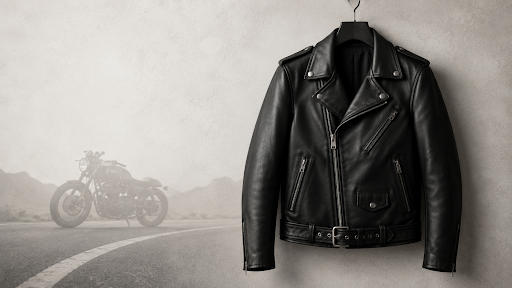
The classic asymmetrical motorcycle jacket is closely associated with the Schott Perfecto, introduced in 1928. Its diagonal closure was not merely decorative. The overlapping front helped reduce wind penetration, while the short body avoided bunching when the rider sat on a motorcycle. Zipped cuffs closed around the wrists, and a belted waist helped keep the jacket stable. These practical details eventually became the visual grammar of the biker jacket.
A substantial collar could be closed against wind or opened in milder weather. Heavy leather offered durability and some abrasion resistance, although modern riders should distinguish traditional leather clothing from certified protective motorcycle equipment.
Hollywood Changed the Meaning
The jacket’s public identity changed during the 1950s. Marlon Brando’s appearance in The Wild One connected the black leather motorcycle jacket with youth rebellion, independence, and resistance to authority. People who had never ridden a motorcycle could recognize what the jacket appeared to represent.
The jacket stopped communicating only a practical message. It no longer said simply, “I ride a motorcycle.” It could also suggest confidence, danger, or nonconformity. Designers and wearers began borrowing that symbolism even when the original riding function was unnecessary.
Music Made It Belong to Subcultures
Rock and punk musicians later pushed the biker jacket further from its functional roots. Groups such as the Ramones made black leather part of a stripped-down visual uniform. Unlike elaborate stage costumes, it felt accessible and connected to the street.
Its appeal came partly from contradiction. It looked uniform but allowed individuality. It had an established history but could be adopted by each new generation. That flexibility helped it survive changing trends.
Motorcycle Clubs Added Community Meaning
Motorcycle clubs also influenced how the public understood black leather. For members, riding clothing could communicate belonging, shared experience, and readiness for long hours on the road. Yet popular media often reduced this varied culture to a single outlaw stereotype.
The reality has always been broader. Motorcycle clubs have included veterans, touring groups, police riders, religious organizations, charity riders, and local social communities. Black leather was practical because it hid oil and road marks, while patches and insignia could identify club relationships. The clothing carried community meaning, not simply rebellion.
Fashion Removed the Motorcycle but Kept the Attitude
Once designers adopted the biker jacket, they changed its proportions, materials, colors, and fit. Some versions became lighter, slimmer, softer, or more decorative. Others retained the diagonal zipper and lapels but removed the weight and reinforcement associated with riding.
This created two related but different categories: motorcycle jackets designed for use on a bike, and fashion jackets inspired by motorcycle history. They may look similar, but they should not be treated as interchangeable. A fashion jacket can express the visual language of motorcycling without providing impact armor, tested seams, or riding-specific coverage.
That transition explains why the design still feels authentic in motorcycle culture and familiar far beyond it today.
Why the Jacket Still Matters to Riders
Despite its success in fashion, the biker jacket remains tied to motorcycles because its most recognizable details were created around a rider’s needs. The design still suggests motion and independence.
For riders, this history offers a useful reminder: appearance and protection are separate considerations. Road use requires attention to fit, abrasion resistance, closures, seam construction, armor, and coverage. Modern motorcycle jackets may use leather or specialized textiles, and each garment should be judged by its intended purpose rather than appearance alone.
A Rare Piece of Living Motorcycle History
The leather biker jacket did not leave motorcycle culture behind when it entered mainstream fashion. Instead, it carried fragments of that culture into new settings. Every diagonal zipper, cropped waist, wide lapel, and zipped cuff still refers back to practical problems faced by early riders.
That is why the jacket remains recognizable nearly a century after its introduction. It is not simply an old garment that stayed fashionable. It is a piece of functional motorcycle design that accumulated new meanings without completely losing its original one.