
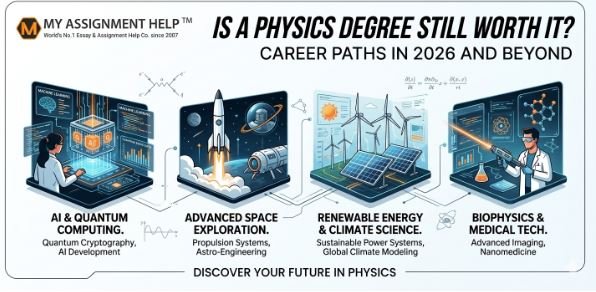
For decades, a degree in physics was viewed as the ultimate intellectual marathon—a rigorous journey through Maxwell’s equations and quantum mechanics that signaled to the world you were a “problem solver.” However, as we cross the threshold of 2026, the higher education landscape is shifting toward skills-based hiring and AI-integrated workflows. This leads many prospective students to ask: Is the classic physics degree still a viable investment?
The short answer is a resounding yes, but with a caveat. The value of a physics degree in 2026 lies less in the specific formulas memorized and more in the “physics mindset”—the ability to model complex systems and derive solutions from first principles.
The 2026 Job Market: Where Do Physicists Go?
The traditional image of a physicist confined to a chalkboard or a particle accelerator is outdated. Today, the “hidden” physicist population is booming in sectors that didn’t exist a decade ago. According to recent labor statistics, the analytical rigors of the field make graduates highly sought after in emerging tech hubs across the United States.
If you are currently struggling with the transition from classical mechanics to these modern applications, seeking physics assignment help can provide the conceptual clarity needed to master the high-level modeling required in the professional world. This foundational strength is what separates a standard coder from a systems architect.
1. Quantum Computing and Information Science
With the commercialization of quantum advantage, companies like IBM, Google, and a host of startups are desperate for “Quantum Engineers.” A physics background is the only direct pathway into this field, which is projected to contribute billions to the global economy by 2030.
2. Renewable Energy and Climate Modeling
As the U.S. pushes toward aggressive carbon-neutrality goals, physicists are at the forefront of battery chemistry, photovoltaic efficiency, and atmospheric fluid dynamics.
3. Quantitative Finance and Algorithmic Trading
Wall Street continues its love affair with “Quants.” The ability to apply stochastic calculus—a staple of advanced physics—to market fluctuations remains one of the highest-paying career paths for graduates.
Data-Driven Insights: Employment and Salary Trends
Research from the American Institute of Physics (AIP) and the Bureau of Labor Statistics (BLS) indicates that while “Physicist” as a job title is growing at an average rate, the employment of physics degree holders in related fields is skyrocketing.
| Career Path | Median Salary (2025/26 Est.) | Required Skillset |
| Data Scientist | $125,000 | Statistical Modeling, Python |
| Quantum Engineer | $140,000 | Quantum Mechanics, Cryogenics |
| Energy Researcher | $98,000 | Thermodynamics, Material Science |
| Aerospace Systems | $115,000 | Fluid Dynamics, CAD |
Despite these lucrative outlooks, the academic workload can be overwhelming. Many students finding themselves buried under lab reports and complex derivations often choose to do my assignment through professional academic services to maintain their GPA while focusing on building a portfolio of practical skills like C++ or SQL.
The Integration of AI in Physics Education
In 2026, the curriculum has evolved. Top-tier universities are no longer just teaching theory; they are teaching Computational Physics. Students are now using AI to simulate experiments that would have taken months to run in a physical lab. This synergy between “Big Science” and “Big Data” is the primary reason the degree remains worth it. You aren’t just learning how the universe works; you are learning how to handle massive datasets—the most valuable currency in the modern economy.
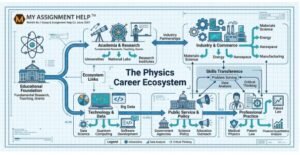
Infographic Blueprint: The Physics Career Ecosystem
Key Takeaways
- Versatility is King: A physics degree is essentially a “universal key” that opens doors in finance, tech, and engineering.
- High Salary Floor: Even those who leave the field of science entirely tend to earn more than their peers due to superior mathematical literacy.
- Future-Proof: While AI can write code, the ability to define the physical constraints of a system (The “Why” behind the “How”) remains a uniquely human-physics skill.
- Skill Supplementation: To maximize ROI, students should pair their degree with minor certifications in Machine Learning or Data Analytics.
FAQs
Q: Is a Master’s or PhD required to get a job?
A: Not anymore. While research roles require a PhD, “Private Sector” roles in data science and engineering highly value Bachelor’s holders who have strong internship experience.
Q: How does a physics degree compare to an engineering degree?
A: Engineering is about applying known rules to build things; Physics is about discovering those rules. In the job market, physicists are often hired for “R&D” (Research and Development) while engineers are hired for “Operations.”
Q: Are physics graduates being replaced by AI?
A: Quite the opposite. Physicists are the ones building the next generation of AI, particularly in the realm of Neural Networks and physical-informed machine learning.
Author Bio
Dr. Mark Harrison
Senior Academic Consultant at MyAssignmentHelp
A graduate of the Wharton School (MBA) with a background in Applied Sciences, Mark specializes in bridge-building between complex academic theory and market-ready career strategies. With over a decade of experience in higher education consulting, he helps students navigate the intersection of STEM and professional success.
References
- Bureau of Labor Statistics (2025). Occupational Outlook Handbook: Physicists and Astronomers.
- American Institute of Physics (AIP). “Initial Employment Report: Physics Bachelor’s, 2024-2026.”
- National Science Foundation (NSF). “The State of U.S. Science and Engineering 2026.

